Details of Partial Pivoting LU Decomposition in EmbeddedMath
14 Feb 2025Implementation Details of Matrix Decomposition
1. LUP Decomposition
We take column major partial pivoting LU decomposition. Since the matrix data are stored in column major order, we swap the columns in the matrix data directly.
1. Partial Pivoting
We use column major partial pivoting to improve the numerical stability of the LU decomposition.
The LU decomposition might fail if the top left entry in matrix $A$ is zero or too small. To avoid this, we swap the current column with the column that has the largest entry. This is called partial pivoting.
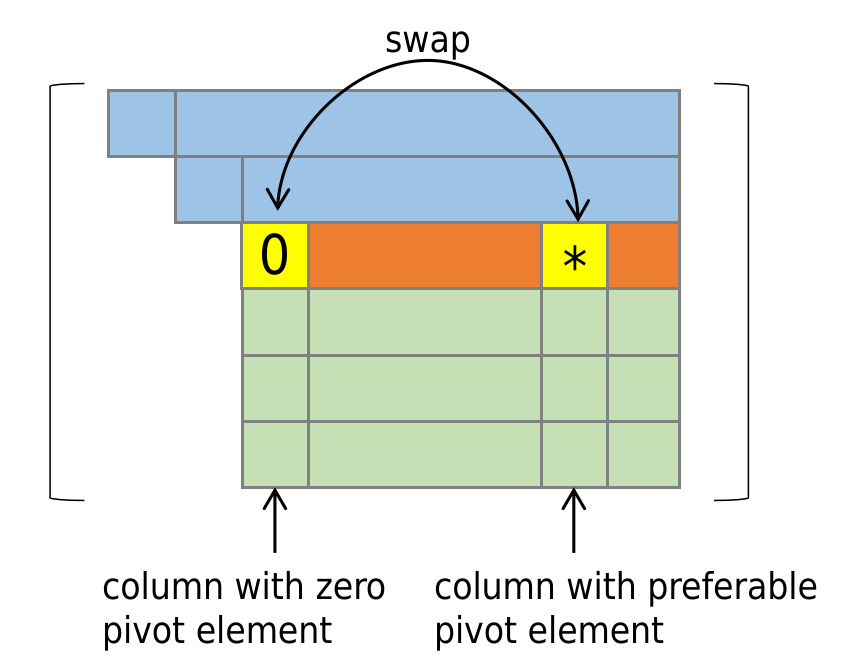
Let the i-th column own the largest entry. We swap the i-th column with the current column. We can represent this operation by a permutation matrix $P$.
2. Why column major pivoting?
Different from usual LUP algorithm, we use column major partial pivoting. The reason is that the matrix data are stored in column major order. If we do column major pivoting, we just need to swap data in column, which is continously stored in memory.
Note that this change will cause different results from the usual LUP algorithm. For example, in a normal LUP algorithm, the resulting L matrix is a lower unit triangular matrix, but in our column major pivoting LUP algorithm, the resulting U matrix will be upper unit triangular matrix.
3. Permutation Matrix
Given a matrix $A \in \mathbb{R}^{m \times n}$, we want to decompose it into $AP=LU$, where $P$ is a permutation matrix, $L$ is a lower triangular matrix, and $U$ is an upper triangular matrix.
$P$ is a permutation matrix, which does a column swap operation on any matrix that is multiplied by $P$. For example, swapping ith column and jth column can be represented by a permutation matrix $P$ such that $P_{ij} = P_{ji}= 1$ and $P_{ii} = P_{jj} = 0$.
\[AP:=\overline{A}\] \[P:\begin{pmatrix}\\ 0 & 0 & \cdots & 1(ith) & \cdots & 0 \\ 0 & 1 & \cdots & 0 & \cdots & 0 \\ \vdots & \vdots & \ddots & \vdots & \ddots & \vdots \\ 1(jth) & 0 & \cdots & 0 & \cdots & 0 \\ \vdots & \vdots & \ddots & \vdots & \ddots & \vdots \\0 & 0 & \cdots & 0 & \cdots & 1 \\ \end{pmatrix}\]4. LUP decomposition
Firstly, we perform partial pivoting on the matrix $A$, the permutation matrix is denoted as $P_{1}$. so $\overline{A}=AP_{1}$. The next permutation matrix $P_{2}$ shall be written as
\[P_{2} =\begin{pmatrix} 1 & \textbf{0} \\ \textbf{0} & P_{22} \\ \end{pmatrix},\]where $P_{22}$ is an $(n-1)\times(n-1)$ permutation matrix. So the overall permutation matrix is $P = P_{1}P_{2}$. We can write the LUP decomposition as
\[AP = LU\] \[\overline{A}P_{2} = LU\] \[\begin{pmatrix}\overline{a}_{11}&\overline{\boldsymbol{a}}_{12}\\ \overline{\boldsymbol{a}}_{21}&\overline{A}_{22} \\ \end{pmatrix}\begin{pmatrix}1 & \textbf{0}\\ \textbf{0} & P_{22}\\ \end{pmatrix}= \begin{pmatrix}{l}_{11} & \textbf{0}\\ \boldsymbol{l}_{21} & {L}_{22}\\ \end{pmatrix}\begin{pmatrix}1 & \boldsymbol{u}_{12}\\ 0 & {U}_{22}\end{pmatrix}\] \[\begin{pmatrix}\overline{a}_{11} & \overline{\boldsymbol{a}}_{12}P_{22}\\ \overline{\boldsymbol{a}}_{21} & \overline{A}_{22}P_{22} \\ \end{pmatrix} =\begin{pmatrix}{l}_{11} & l_{11}\boldsymbol{u}_{12}\\ \boldsymbol{l}_{21} & \boldsymbol{l}_{21}\boldsymbol{u}_{12}+{L}_{22}U_{22} \\ \end{pmatrix}\]Equating the corresponding entries, we have
\[\overline{a}_{11}=l_{11}\] \[\overline{\boldsymbol{a}}_{21} =\boldsymbol{l}_{21}\] \[\overline{\boldsymbol{a}}_{12}P_{22}=l_{11}\boldsymbol{u}_{12}\] \[\overline{A}_{22}P_{22}=\boldsymbol{l}_{21}\boldsymbol{u}_{12}+{L}_{22}U_{22}\]Substituting the first three equations above into the last one, we have
\[S_{22}P_{22}=(\overline{A}_{22}-\overline{\boldsymbol{a}}_{21}(\overline{a}_{11})^{-1}\overline{\boldsymbol{a}}_{12})P_{22}=L_{22}U_{22},\]where $S_{22}$ is the shur complement.
Recursively decompose $S_{22}$, resulting in $L_{22},U_{22}$ and $P_{22}$. Solve $L$ and $U$ by back substitution.
Finally, reconstruct the full matrices $L$, $U$ and $P$.
5. API
APIs for LUP decomposition are a bit different from Eigen library. Because the way I implement LUP decomposition is different from the way Eigen library does.
- Inplace Matrix Decomposition is currently not supported, since we don’t deal with large matrix. But it can be implemented easily.
EmbeddedMathuses a column major partial pivoting rather than row major partial pivoting, since swapping rows is more costly than swapping columns. This leads to a different permutation matrix and diffrent resulting matrices.
Following APIs are currently supported.
//create a PartialPivLU object
EmbeddedMath::PartialPivLU<EmbeddedMath::MatrixType> lu(A); // will decompose matrix A automatically

// get the permutation matrix
EmbeddedMath::MatrixType P = lu.permutationP();

// get the lower triangular matrix
EmbeddedMath::MatrixType L = lu.matrixL();

// get the upper triangular matrix
EmbeddedMath::MatrixType U = lu.matrixU();

// return the determinant of matrix A
auto det = lu.determinant();

// return the inverse of matrix A
EmbeddedMath::MatrixType inv = lu.inverse();
2. QR Decomposition
TO DO…
3. SVD Decomposition
TO DO…